Pricing
You cannot price AI legal work from historic time entries
The evidence base underneath legal pricing is quietly going out of date. Here is what replaces it.
10 August 2026 · Romano Plescia, Founder & CEO
Pricing software for law firms works from one source of truth: what the firm's people recorded against similar matters in the past. Feed it enough closed matters and it will tell you what a carve-out or a facility refinancing has historically taken, by grade, by phase, and what to quote.
That is a good machine, and it is running out of fuel. The moment part of a matter is delivered by software, the time entries stop describing the work. So the leading products bolt on an adjustment: an admin sets a percentage reduction per fee-earner grade to account for AI, and the quote is scaled down accordingly.
Read that again, because it is the whole argument. The number that decides how much AI changes your price is typed in by a person. It has to be. Historic time entries do not contain the future, and a tool built on them has no way to observe what the software actually did.
The asymmetry
Trovato is on the other side of that gap. It ran the review. It knows the contract had 113 clauses, that 26 of them deviated from the firm's playbook, how long the pass took, and — because every model call freezes its cost at the moment it is made — exactly what it cost to run. None of that is an assumption. It is a measurement, and it is already in the database.
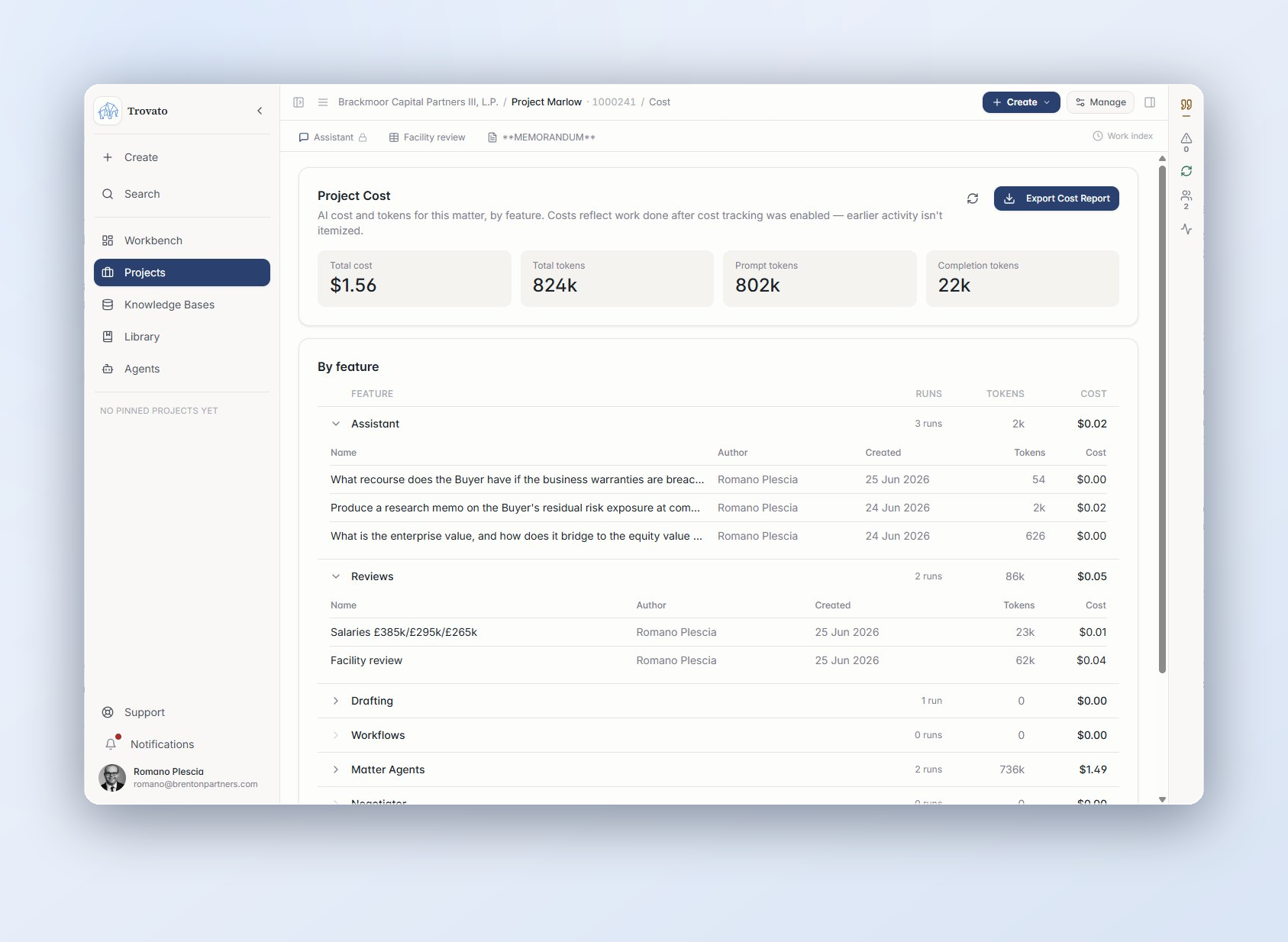
The asymmetry compounds. As more delivery moves into software, a precedent bank built on human hours describes less and less of the matter, while a record of what the software actually did on real matters gets denser. The two lines cross. We think they cross sooner than most firms expect.
Four numbers, and why we refuse to merge them
The obvious product here is a single confident figure — "AI saved you £5,900 on this matter". We do not ship that number, and the reason is worth stating plainly: it is unfalsifiable. It quietly adds together two different claims, and once they are added you can never check either one.
So a priced deliverable carries four separate figures. The price you charge, from your own rate card. The human counterfactual — what you would have charged for the equivalent human work. The cost floor — what the AI work actually cost to run, metered and frozen. And the human cost — what the human equivalent would have cost the firm to deliver. Margin is price less floor. Cost saving is human cost less floor. Both are visible; neither is folded into the other.
A unit the client can check
Pricing per run is too coarse to defend: a review over three documents and a review over three hundred are not the same deliverable. So a rate-card line prices per document, per clause, per page or per review cell, and the quantity comes from the run itself.
Where a count genuinely cannot be resolved, the line is flagged "Assumed" and priced as one unit. That flag is not a limitation we are apologising for — it is the feature. A pricing report that silently invents a quantity is worse than one that admits which line it could not measure.
What we deliberately did not build
No invoices, no receivables, no payments. Work types are coded to the SALI legal-matter standard with a mapping to UTBMS, so the output flows into the billing system the firm already runs rather than trying to replace it.
And no cross-firm benchmarking. Comparable-matter figures come only from a firm's own closed matters. Exchanging price information between competing firms is a competition-law question, not a product question, and we are not going to answer it with a feature flag. A cohort below three comparable matters is suppressed rather than widened until a number appears.
The honest summary: we can price the AI-delivered scope because we delivered it. For everything else, your existing tooling is better than ours, and we would rather feed it than fight it.