Skip to content
Trovato

Pricing Intelligence

Headline

Price the work, because you did the work.

Every AI deliverable is classified, priced against your rate card and shown beside what it actually cost and what the human equivalent would have cost. Four numbers, deliberately never merged into one.

All capabilities

01What it is

Competing tools estimate what AI does to a quote by adjusting assumptions built from historic human time entries. Trovato performed the delivery, so it measures it — every run classified, priced on a unit a client can check, and set beside what it actually cost.

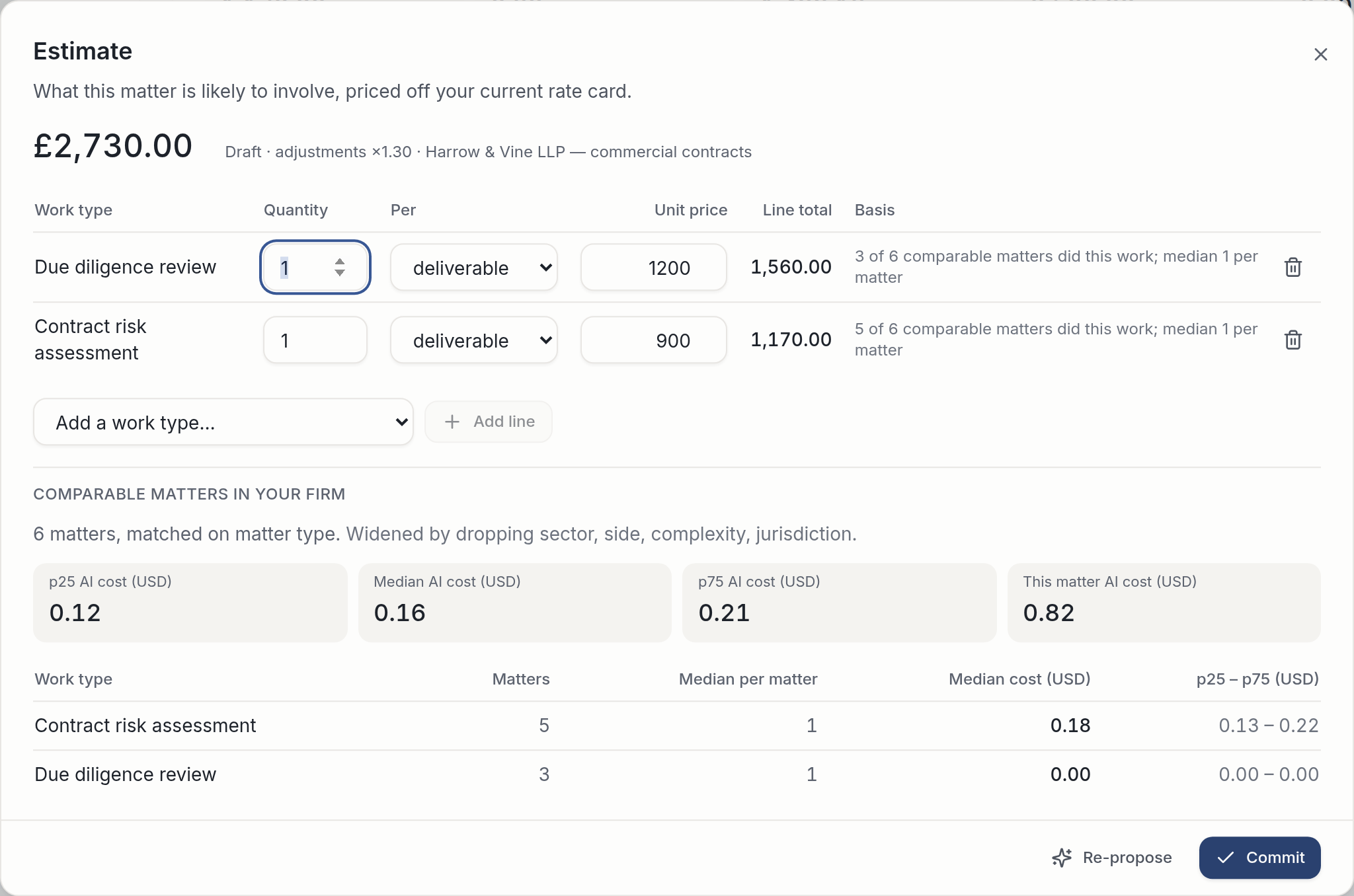
The estimate dialog: a GBP 2,730.00 total beside a draft label, the ×1.30 adjustment product and the rate card it was priced off. A table of editable lines shows quantity, the unit each is priced per, unit price and line total, with a Basis column explaining where each number came from — “3 of 6 comparable matters did this work; median 1 per matter”. Below, a comparable-matters section names the cohort, states which facets were dropped to reach it, and gives its lower quartile, median and upper quartile AI cost against this matter's.
In the productA forward estimate where every line says where its number came from — and which facets were dropped to find the cohort

02In detail

01

Classified, not guessed

Every spend-bearing run is coded to a work type from the SALI legal-matter standard, with a UTBMS mapping so the codes drop into the e-billing tooling you already run. The classifier reads run metadata only — titles, feature, practice area — never the client's documents.

02

Priced on a unit a client can check

Per run, per document, per clause, per page or per review cell, against a versioned firm rate card whose published versions are immutable. Where a count genuinely cannot be resolved the line is flagged “Assumed” rather than given an invented quantity.

03

Four numbers, never merged

The price, the human counterfactual, the metered cost floor, and what the human equivalent would have cost the firm. Conflating what you made with what you avoided spending is exactly what makes a single “AI ROI” figure unfalsifiable.

04

Estimate, then measure

Propose an estimate from comparable matters in your own history, commit it — a committed estimate is frozen, and re-estimating supersedes rather than edits — then see delivery measured against it, with any drift in the matter's own multipliers disclosed separately from genuine variance.

03In practice

Pricing intelligence

What it cost, what it's worth, what it saved.

Comparisons are drawn from your own firm's closed matters, and a cohort with fewer than three comparable matters is suppressed rather than widened until a number appears.

Rate card · commercial contractsGBP · published v4
Contract review — per document14 × £350Resolved
Diligence sweep — per run1 × £1,200Assumed
Negotiation round — per clause26 × £45Resolved

Where a unit count genuinely cannot be resolved, the line is flagged “Assumed” and priced as one unit — never given a quantity the platform did not measure.

Quantity scales effort; the matter's multipliers scale value. Ten documents really is ten times the hours — a risky matter is not.

Price

£7,840

14 documents · complexity ×1.60, derived from “novel”

Human counterfactual

£13,020

42.0 hrs at charge-out rate

Cost floor · metered

£61

Frozen at write, indexing included

Cost saving

£5,903

Human cost less the metered floor

Margin over the floor is £7,779. It is reported separately from the cost saving on purpose: what you made and what you avoided spending are different claims, and one number covering both cannot be checked.

Cohort: 7 comparable matters · your firm only · FX as of 09 Aug 2026

04Why it matters

How it fits the matter

A pricing professional can be put on a matter and work its estimate, its adjustments and its cost report without ever seeing its documents, its threads or its drafts — a role that grants the pricing lifecycle and nothing else.

05Questions

Straight answers

What people ask before they buy this.

Does this tell me what to charge?
No. You set the rate card; the platform applies it, and shows the price beside what the work actually cost to run and what the human equivalent would have cost. It is a reporting and estimating aid, not a recommendation engine.
Is this an invoicing or billing system?
No. There are no invoices, no accounts receivable, no tax handling and no payments. Work types are coded to the SALI standard with a UTBMS mapping, so the output feeds the billing and e-billing tooling your firm already runs.
Are the benchmarks drawn from other firms?
Never. Comparable-matter figures come only from your own firm's closed matters. Cross-tenant benchmarking is not offered, and a cohort with fewer than three comparable matters is suppressed rather than widened until a number appears.
What happens to work we ran before this was switched on?
It stays unclassified and unpriced. Costs are frozen at the moment each model call is made and are never re-priced retrospectively, so historical work is reported as out of scope rather than estimated after the fact.
Can pricing staff see the matter's documents?
Only if you give them a role that allows it. A pricing attachment grants the pricing lifecycle — characteristics, estimate, adjustments, cost report — and no access to the matter's documents, threads, reviews or drafts.

See Trovato on your own matters.

A short, tailored walkthrough — the citation firewall, the Matter Wiki, and a supervised agent, working on the kind of matter you run.

Talk to us